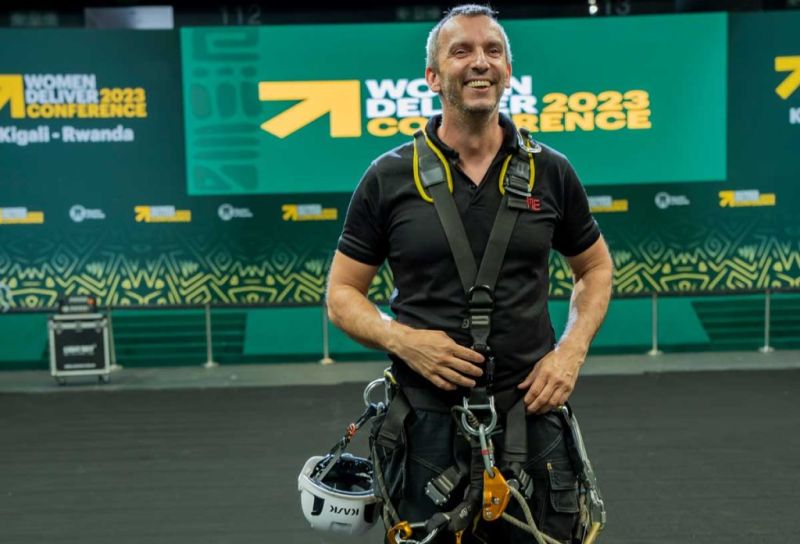
In the first of our new Meet the Members series, we’re shining a spotlight on Alexander Würfel, Group CEO of ES:ME, and the experience, ambition and specialist expertise behind the company’s Rope Access & Difficult Access division.
From school discos and techno raves to installing hundreds of lights across skyscrapers, Alexander’s career has been anything but conventional. We caught up with him to explore the difference between rigging and rope access, the extraordinary projects made possible by combining the two, and why a hands-on, “whatever it takes” attitude remains at the heart of ES:ME.
What first attracted you to the industry, and how has that shaped your leadership?
I grew up around events—my uncle and grandfather ran the only pub in our village and organised every local festival. As a teenager, I was running the school disco and staging techno raves. Professionally, I was hooked the first weekend I helped with artist security.
Those early years doing everything—security, rigging and logistics—taught me that reputation comes from dependability. I still lead hands-on: I pull the car from the front rather than pushing from behind, and that calm, respectful approach runs through the whole team.
What is the real difference between rope access and rigging, and why does it matter?
Rigging is a whole discipline in itself, and the term actually comes from sailing rigs—suspending and hauling loads safely using ropes. Engineering and planning a rigging production is only one part of that. You do not need rope-access people for an exhibition rigging job, for example.
Riggers have a basic understanding of working at height and simple rescue scenarios, but their real depth of knowledge goes into load distribution, anchor points, dynamic load factors and bridle calculations. Rope access is a separate certified discipline for reaching difficult positions safely. Most of our riggers hold rope-access qualifications too, so our people understand both.
What does combining rope access with technical production let your team do differently?
It means we do not need to bring in outside specialists just to reach difficult positions—our own technicians already hold the certifications and engineering knowledge to do it safely.
That opens up work most integration companies cannot take on, including façade lighting, permanent stadium installations and specialist access on skyscrapers. Standard rope-access companies are excellent at things like window cleaning, servicing wind turbines or working offshore on oil rigs, but that is a completely different discipline from technical event production. What sets ES apart is combining both bodies of knowledge in one team.
Is there one project that shows what becomes possible when these skills combine?
Noor Riyadh’s DIALOGUE installation for Christopher Bauder in 2023 is a good example. We handled the logistics, engineering and infrastructure integration for hundreds of moving lights, LED floodlights and lasers installed across multiple skyscrapers.
Our team needed rope access to work safely at height on the towers, alongside the rigging expertise to make it all possible. The precision required—down to exact elevator timings—was almost military, and the result became a centrepiece of the festival.
What should venue operators consider now to prepare for increasingly ambitious productions?
Invest in permanent rigging points and infrastructure rather than treating every show as a one-off build—it saves time, cost and risk in the long run. Bring in specialist expertise early in the planning process, not once the show design has been finalised.
And prioritise safety training across the board. We still see too many accidents involving people working at height without the right harnesses or equipment, particularly in fast-growing markets such as Saudi Arabia.
Where do you see the greatest opportunities for rope access in live events?
There is huge potential in stadium installations, permanent infrastructure and façade lighting, particularly as cities such as Riyadh continue building at pace.
Rope access also gives companies like ours a strong business stream that keeps people working even when live events slow down, because construction projects continue regardless. The biggest opportunity is for teams that combine access skills with genuine technical understanding, rather than treating rope access as a standalone service.
What advice would you give someone considering a career in rigging or rope access?
Say yes to opportunities even when they fall outside your comfort zone—my career started because I said yes to a security job I knew nothing about.
Never let “that is not my job” become part of your vocabulary; a whatever-it-takes attitude is what gets you trusted with bigger projects. And invest properly in your safety training from day one—it is the foundation everything else is built on.
Could ES:ME support your next project? ES’s Rope Access & Difficult Access division works across stadium developments, permanent PA and lighting installations, façade lighting and other technically challenging locations. If its expertise could help bring your next project to life, connect with Alexander and the ES team to start a conversation.